Enticing (vs. dull)
This primal concerns how much we see the world as generally full of interesting and beautiful things or dull and ugly things. In their foundational 2019 paper, Clifton and his research team describe Enticing like this:
Those low on Enticing inhabit dull and ugly worlds where exploration offers low return on investment. They know real treasure—truly beautiful and fascinating things—is rare and treasure-hunting appropriate only when it’s a sure bet. Those high on Enticing inhabit an irresistibly fascinating reality. They know treasure is around every corner, in every person, under every rock, and beauty permeates all. Thus, life is a gift, boredom a misinformed lifestyle choice, and exploration and appreciation is the only rational way to live.

The world is full of wonderful things you haven’t seen yet.
— J. K. Rowling, 2015 tweet
How Enticing Relates to the Other Primals
Along with Safe and Alive, Enticing is one of the “big three” primals and is thus one of the major reasons for seeing the world as Good. Enticing itself is also made up of the following seven primals about more specific qualities:
- Interesting (vs. boring)
- Beautiful (vs. ugly)
- Abundant (vs. barren)
- Worth Exploring (vs. not worth exploring)
- Meaningful (vs. meaningless)
- Improvable (vs. too hard to improve)
- Funny (vs. not funny).
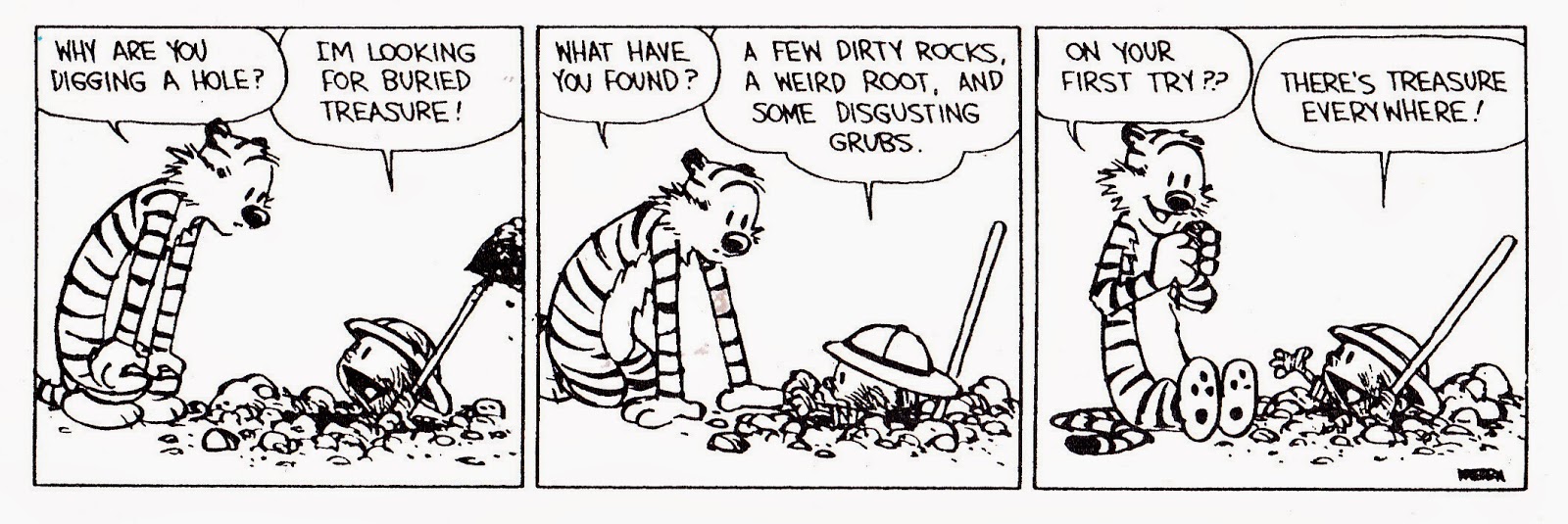
There’s treasure everywhere.
— Calvin, 1996, Calvin & Hobbes by Bill Watterson
Interpreting Enticing Scores
Please note that the ranges provided below are somewhat outdated and based on an early version of the Primals Inventory. They are provided for reference only.
| Scores | % of U.S. | Implicit Reality | Description |
| 0-2.3 | 5% | An extremely dull world | Those in this range tend to see activities, people, and places as not worth exploring until proven otherwise. Beautiful and fascinating things are few and very far between. Ubiquitous curiosity may seem naïve. |
| 2.3-3.1 | 20% | A somewhat boring world | Those in this range also may see extremely curious people as a bit naïve but are themselves more likely to think that some things are worth exploring. |
| 3.1-4.3 | 50% | A somewhat interesting world | The average American scores a 3.7 and tends to see the world as somewhat interesting. Those in the middle are least likely to see themselves as holding a belief about the world. They can relate to everyone but may be a bit baffled by the behavior of those on both extremes. Even within this large group (50% of the population), a person’s score may still matter quite a bit. |
| 4.3-4.9 | 20% | A fascinating world | Those in this range tend to be very curious people. They may expect people they meet to be interesting and the places they go to be fascinating; they may seem nearly always excited to explore further. They might not understand people who lack curiosity and wonder why they don’t “get it.” |
| 4.9-5 | 5% | An irresistibly enticing world | Thankful for everything life has to offer, those scoring very high tend to go through life expecting beauty and fascination around every corner and are drawn to see and do as much as possible. To them, it may seem like the only rational and appropriate response to a world permeated by and saturated with immense beauty, meaning, and abundance. They might find people who get easily bored to be wholly alien—and have lots of questions for them. |
Why is Enticing a big deal?
Identifying Enticing is probably the single most important discovery of primals research so far. While Safe has been studied to a small degree, Enticing was both wholly unexplored and is of immense practical importance. Enticing may play an enormous role in one’s own well-being and mental health; its relationship to wellbeing is very large, about the same as the relationship between surface temperature and latitude in the U.S. It might even be more important to wellbeing than Safe, which often correlates with Enticing (increase and decrease together).
After all, Safe and Enticing are the two main reasons for seeing the world as Good (Alive is icing on the cake). However, sometimes Safe and Enticing work very differently. For example, it appears almost impossible to be a curious person or a grateful person without scoring high on Enticing. But, when it comes to those traits, Safe scores don’t matter much.
Enticing and addiction
A 6-month long study published in 2025 by Dr. Justin Bell at Chestnut Health Systems found that seeing the world as more enticing predicted having more recovery capital: internal resources (things like hope) and external resources (things like friends) that help make addiction recovery easier. Enticing may help people notice opportunities for recovery and support, assuming value in the world around them. Read a summary of this research in this Psychology Today article.

What Does Enticing Predict?
When people are in places they see as really enticing, we would expect them to behave in certain ways, such as being grateful, curious, open to experience, extroverted, and so forth. When it comes to seeing the world as enticing, we see a similar pattern.
Enticing is highly related to a host of personality and well-being variables. These include curiosity, gratitude, openness to experience, agreeableness, extroversion, engagement with life, positive emotion, meaning in life, a sense of accomplishment, having friends, and even quality of sleep. Likewise, scoring low on Enticing is related to psychopathy, depression, not trying, and loneliness.
Interestingly, a 2024 study, summarized in this Psychology Today article, has found that cancer patients who choose palliative care options also tend to see the world as more Enticing, in particular. One of the main goals of palliative care is improving quality of life, so it makes a lot of sense that people who think the world is full of things worth enjoying would try to make sure they’re able to do just that for as long as they can.
We live in a beautiful world / Yeah we do, yeah we do
— Coldplay’s 1999 song Don’t Panic
Family members, friends, and colleagues, who score differently on Enticing may have different baseline assumptions for how worthwhile it might be to investigate vague situations for something wonderful. This may lead to a variety of misunderstandings.
Perhaps a person high in Enticing thinks those low on Enticing are not putting in enough effort, while those low might think others are wasting their time on a fruitless search. Similarly, in theory, those scoring high on Enticing may be able to spot amazing opportunities, but they may also be sucked in by bad ones. Those scoring low on Enticing may be less likely to be fooled or waste their time, but they may be more likely to miss opportunities and have life pass them by.
Disclaimer: All this must be taken with a grain of salt. Research is ongoing.
Photo: Jan Mey/Midjourney

