Hierarchical (vs. nonhierarchical)
Are things better or worse, or just different? This belief concerns whether things can typically be ranked in order of importance or value. It involves an assumption about the extent to which difference implies something is better or worse. On the opposite end is the belief that distinctions don’t matter and difference is largely meaningless. Most things, situations, plants, and even people are neither better nor worse than each other.
[Hierarchy] exists in living creatures, but not in them only; it originates in the constitution of the universe; even in things with no life there is a ruling principle.
— Aristotle, Politics, circa 350 B.C.E.
Hierarchical is one of the five primals that are not part of Safe, Enticing, Alive, or Good. Thus, it is not a belief about whether the world is good or bad. It’s purely about whether or not things in the world can be put in a meaningful hierarchy.
But what things are we even talking about ranking?
Across seven studies published in 2025 with a combined total of 46,700 participants, we found that people’s world beliefs concern both nature and humanity, in about equal measures.
These studies also looked at Hierarchical world belief specifically. It showed that Hierarchical includes rankings across people, animals, plants, and even rocks. This belief is way broader than just a belief about society.
What does Hierarchical predict?
Interestingly, Hierarchical is not connected to variables like well-being and depression, but it is tied to politics.
Most primals do not correlate strongly with political differences. For example, many liberals believe that Republicans would be lower in Safe (i.e., see the world as dangerous). That would explain fear—fear of outgroup members, immigrants, the poor, and so forth—which could lend itself to policies that seek big militaries, big prisons, and less immigration. However, it would not explain other major policy differences, such as lowering taxes on the wealthy.
What’s more, based on research so far, this theory is empirically false. There is little difference between Democrats and Republicans when it comes to Safe; thus it cannot be a major driver of behavioral or policy differences for most people.
Instead, the data show substantial differences between liberals and conservatives when it comes to Hierarchical and important but lesser differences when it comes to Just and Progressing.
“There is nothing either good or bad but thinking makes it so.”
— Shakespeare, Hamlet
In a world that is naturally hierarchical and just but getting worse, the rational thing to do is to constrain change in order to preserve the ethical and wise social order that currently exists. Likewise, in a world that is naturally nonhierarchical and unjust but getting better, the natural thing to do is to aid and speed up the process of flattening the unethical social order that currently exists. This account may be a better explanation of conservative/liberal splits on immigration, taxation of the rich, safety nets for the poor, attitudes towards criminals, and a host of other issues.
Whether or not Americans can ever work out their political differences, it may be useful and even comforting to know a bit more about where each other is coming from. It can help us feel less angry.
Not just about politics
Three studies involving 1,534 Americans found that those who scored lower on Hierarchical reported more sustainable behavior, like recycling and choosing environmentally friendly products. Importantly, this relationship was still there after controlling for political views and personality. One possible explanation is that if you don’t see people, plants, animals, and the earth as being inherently better or worse than one another, you might be more inclined to care for all of them more equally.
Beyond just the American context, we also see that Hierarchical has a lot to do with culture. In a study of 905 families from eight different countries (Colombia, Italy, Jordan, Kenya, the Philippines, Sweden, Thailand, and the United States), cultural differences accounted for 26% of the variation in Hierarchical scores, the largest proportion among the seven primals measured in the study.
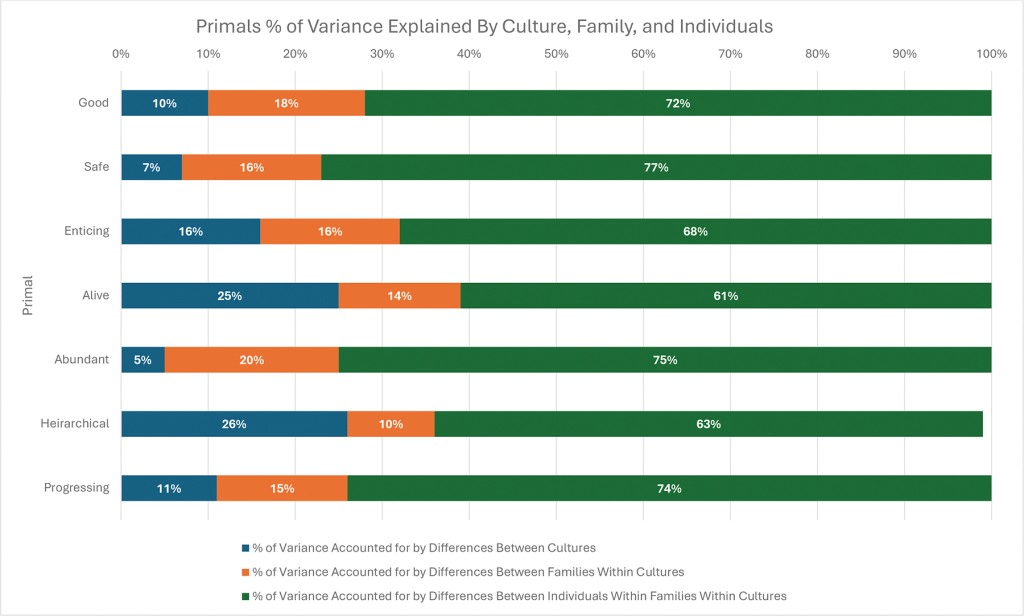
This helps us understand that while Hierarchical world belief is closely related to politics, it’s far from the only thing that it’s related to. It may also help explain how people treat the environment, and it appears to vary substantially across cultures.
More research is needed to unpack what other things are associated with Hierarchical.
- Figure from: Rothenberg, W. A., Lansford, J. E., Deater-Deckard, K., Clifton, J. D. W., Bornstein, M. H., Di Giunta, L., Dodge, K. A., Gurdal, S., Junla, D., Oburu, P., Pastorelli, C., Skinner, A. T., Sorbring, E., Steinberg, L., Tirado, L. M. U., Yotanyamaneewong, S., Alampay, L. P., Al-Hassan, S. M., Bacchini, D., & Chang, L. (2025). Rubbing off on each other: Applying a developmental science perspective to variance in primal world beliefs by family and culture. Applied developmental science, 10.1080/10888691.2025.2501050. Advance online publication. https://doi.org/10.1080/10888691.2025.2501050 ↩︎

