Safe (vs. dangerous)
This primal concerns to what degree we see the world as generally a safe place where threats are real but few and far between or a dangerous place where major threats really are everywhere. In their foundational 2019 research article, Clifton and the research team describe Safe in the following way:
Those low on Safe see a Hobbesian world defined by misery, decay, scarcity, brutality, and dangers of all sorts. Base rates for hazards—from germs to terrorism to getting stabbed in the back—are generally higher. In response to chronic external threats, they remain on high alert, often viewing the non-vigilant as irresponsible. Those high on Safe see a world of cooperation, comfort, stability, and few threats. To them, things are safe until proven otherwise, vigilance appears neurotic, risk is not that risky, and, in general, people should calm down.

You can call me lazy, crazy / Call me stupid I don’t care / I ain’t getting up / It’s dangerous out there.
— Lyrics from Bill Morrissey’s 2009 folk song It’s Dangerous Out There
How Safe Relates to the Other Primals
Along with Enticing and Alive, Safe is one of the “big three” primals and is thus one of the major reasons for seeing the world as Good. Safe itself is made up of the following seven primals that are more specific:
- Pleasurable (vs. miserable)
- Regenerative (vs. degenerative)
- Progressing (vs. declining)
- Harmless (vs. threatening)
- Cooperative (vs. competitive)
- Stable (vs. fragile)
- Just (vs. unjust)
The world is a dangerous place.
— Twitter post, 2012
Interpreting Safe Scores
Please note that the ranges provided below are somewhat outdated and based on an early version of the Primals Inventory. They are provided for reference only.
| Scores | % of U.S. | Implicit Reality | Description |
| 0-1 | 5% | An extremely scary world | Those in this range tend to see all activities, people, and places as dangerous until proven safe. One study found that they guess events like murder and animal attacks as 4.2x higher than those who score high on Safe world belief. People who see the world this dangerous can often stay on high alert because that’s just a rational response to an objectively chronically unsafe world. They might see the care-free as naïve, thinking that they don’t “get it.” |
| 1-1.9 | 20% | A very dangerous world | Those in this range also tend to see most things and situations as dangerous and view care-free people as naïve. However, they likely are more flexible in interpreting events and more easily relax, especially when faced with good information suggesting a risk is not that risky. |
| 1.9-3.2 | 50% | A somewhat dangerous world | The average American scores a 2.5. Those in the middle are least likely to see themselves as holding a belief about the world, but they still do. They can relate to everyone but also may be a bit baffled by the behavior of those on both extremes. Even within this large group (50% of the population), how one scores may still matter a great deal. |
| 3.2-4.2 | 20% | A safe world | Though they tend to interpret ambiguous stimuli in different ways, those in this range tend to assume most things and situations are probably safe. They might view those who see the world as extremely scary as people who need to calm down. |
| 4.2-5 | 5% | An extremely safe world | Those in this range see activities, people, and places as safe until proven dangerous. They guess threatening events like murder and animal attacks to be just 24% of what people who see the world as dangerous think. Importantly, they also tend to be more accurate about threats than people who see the world as dangerous (except when it came to car theft). They might see even “somewhat dangerous world” people as neurotic while suspecting “extremely scary” folks of pathology and thinking they don’t “get it” or had a really hard life. |
What Does Safe Predict?
When people are in places they see as really dangerous, we would expect them to behave in certain ways, such as being irritable, tense, and so forth. When it comes to seeing the world as safe or dangerous, we see a similar pattern.
Safe is highly related to a host of personality and well-being variables. These include agreeableness, extraversion, interpersonal trust, and life satisfaction. Likewise, scoring low on Safe is related to neuroticism, depression, suicidal thoughts, and loneliness.
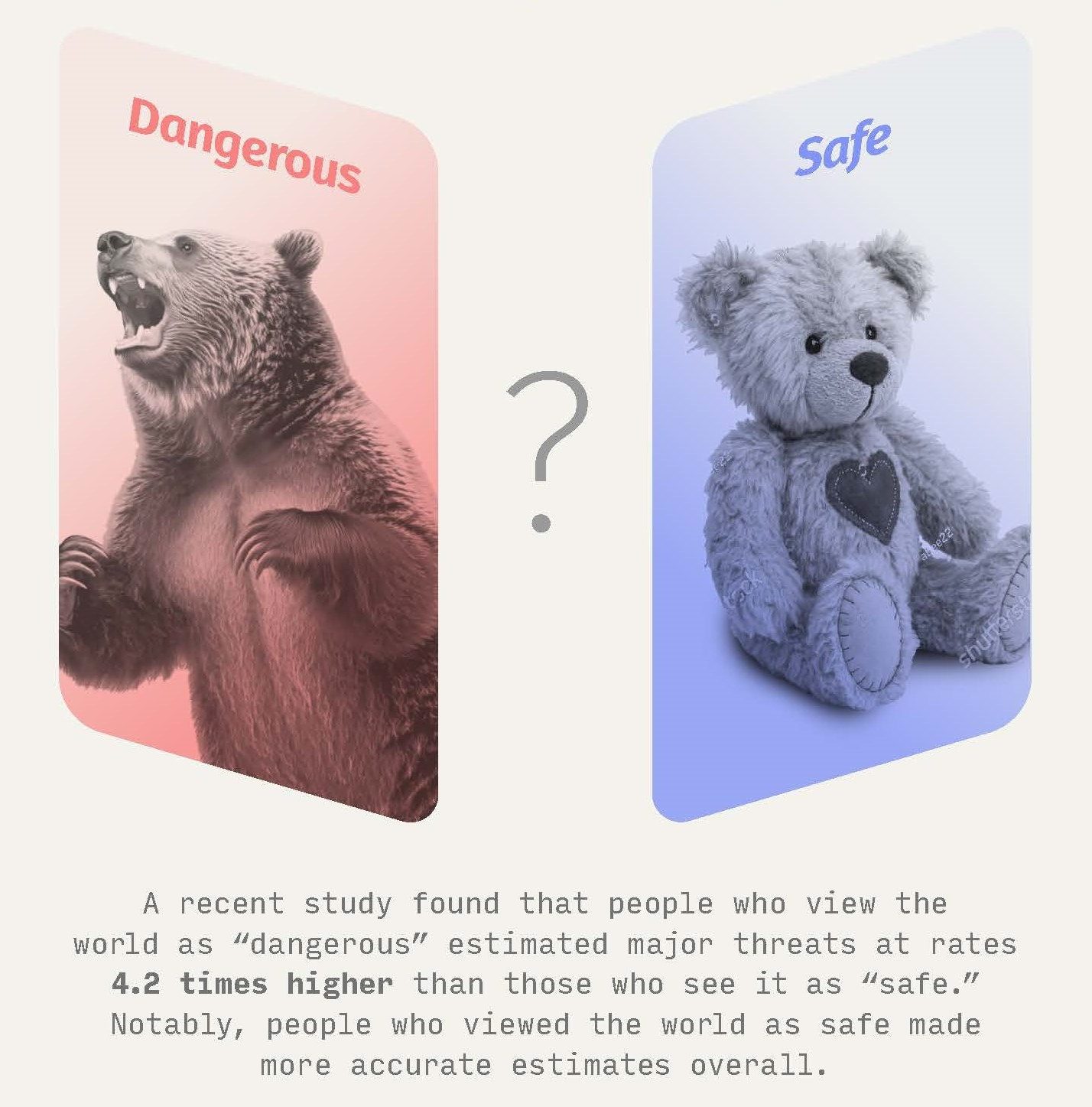
From bear attacks to neutral faces: Dangerous world belief predicts elevated perception of threat
Interestingly, many researchers have long thought that seeing the world as dangerous is related to political conservatism. However, our research challenges that assumption. We’ve found that Safe is only a little related to political beliefs (in fact, among one of the least related) while other primals are much more related.
And in this harsh world draw they breath in pain.
— Shakespeare, Hamlet, 1599
Though we don’t yet know where primals come from, we are starting to realize that Safe scores are not simply determined by our environment. They appear more like a lens through which we view the world than a direct result of our experiences.
For example, though people living in more affluent households are objectively safer than those living in poorer households, there is no relationship between household income and Safe. Also, even though a case could be made that the world is a safer place for men than women, sex is completely unrelated to Safe.
…and which is worst of all, continual fear, and danger of violent death; and the life of man, solitary, poor, nasty, brutish, and short.
— Hobbes’ famous line describing the state of nature, Leviathan, 1651
Researchers at the University of Chicago and the University of Virginia found evidence further supporting the idea that Safe functions as a lens. While conducting a study on a college campus about primals and physical exploration of environments, a school shooting occurred. Following the shooting, students’ Safe scores surprisingly did not change. Instead, Safe predicted how much students physically explored their environment, but only after the shooting– not before. This suggests that once formed, Safe is a relatively stable belief that help us make decisions in ambiguous environments.

This does not mean Safe world belief can’t be changed, just in practice that it doesn’t happen a lot.
Another study found that how people who see the world as dangerous perceive neutral faces as more criminal and less trustworthy. This helps us understand that primals might particularly matter in uncertain circumstances. Read a summary in this PsyPost article.

Family members, friends, and colleagues, who score differently on Safe may have different baseline assumptions for vague situations. This may lead to a variety of misunderstandings and differing opinions. For example, those scoring high on Safe may find it easier to relax, be less suspicious of others, and assume nothing that bad will happen. Those scoring low on Safe may find it harder to relax, be more suspicious of others, and assume the worst.
Disclaimer: All this must be taken with a grain of salt. Research is ongoing.

