Alive (vs. mechanistic)
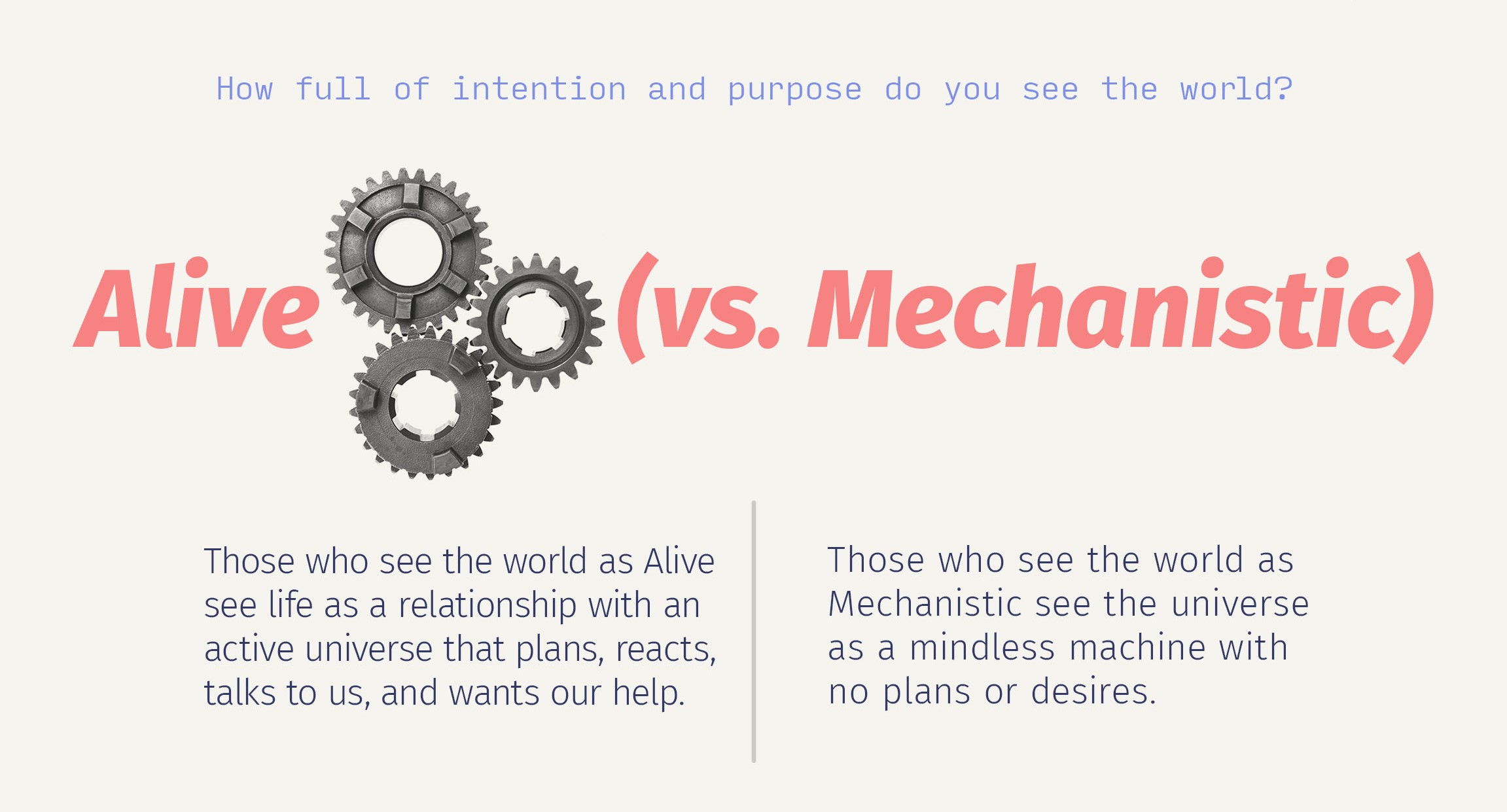
This primal is about how much we see the world as full of intention and purpose that is interacting with us and wants our help. In their foundational 2019 paper, Clifton and his research team describe Alive like this:
Those low on Alive inhabit inanimate, mechanical worlds without awareness or intent. Since the universe never sends messages, it makes no sense to try to hear any. Those high on Alive sense that everything happens for a purpose and are thus sensitive to those purposes. To them, life is a relationship with an active universe that animates events, works via synchronicity, communicates, and wants help on important tasks.
That’s the day I realized that there was this entire life behind things, and this incredibly benevolent force that wanted me to know there was no reason to be afraid, ever.”
— Ricky, American Beauty, 1999
How Alive Relates to the Other Primals
Along with Safe and Enticing, Alive is one of the “big three” primals and is thus one of the major reasons for seeing the world as Good. However, Alive is less central; it’s more like the cherry on top. Alive itself is also made up of a few primals about more specific qualities. These include the belief that the world is Intentional (vs. unintentional), Needs Me (vs. doesn’t need me), and Interactive (vs. indifferent)..
Nothing happens by accident.
—Qui-Gon Jinn, Star Wars, 1999
Interpreting Alive Scores
Please note that the ranges provided below are somewhat outdated and based on an early version of the Primals Inventory. They are provided for reference only.
| Scores | % of U.S. | Implicit Reality | Description |
| 0-.9 | 5% | An utterly mechanistic universe | Those scoring very low tend to see a universe that never sends messages, works through coincidences, or guides anything at all. Even if it could, the universe has no desires, opinions, inklings, or thoughts of any type. In this world, events result from purely mechanistic forces, and religion, spirituality, superstition, and any other attempt to interpret some broader, non-human meaning may seem at worst pathologically self-absorbed and at best blind. |
| .9-2.2 | 20% | A not quite purely mechanical world | Those in this range also may see the world as mechanistic, but not wholly. They feel that, every once in a while, the universe has a thought or desire or that an event is somehow meant to happen. But such events are rare, and it could make little sense to keep an eye out for them. |
| 2.2-3.5 | 50% | A not quite alive world | The average American scores a 2.8. This means they tend to see the world as slightly Alive, but not by much. Those in the middle are least likely to see themselves as holding a belief about the world at all, but they do. They can relate to everyone but may be a bit baffled by the behavior of those on both extremes. Even within this large group (50% of the population), where one scores may still matter a great deal. The universe could have desires and intentions, but they don’t necessarily influence lots of events. |
| 3.5-4.5 | 20% | A mostly alive world | Those in this range tend to see the world as alive, intentional, and purposefully behaving. Though some events have no meaning, keeping your eyes and ears open for what the universe—whether understood as God, fate, the force, etc.—has in mind is just good sense. |
| 4.5-5 | 5% | A fully awake, alive, and interactive universe | Those scoring very high typically see a world with thoughts, feelings, and desires—often about them individually—that are expressed through everything that happens and responsive to many things they do. Thus, having an ongoing relationship with the universe (or God, fate, etc.) can feel like an inescapable part of life. Those who choose to ignore this relationship could seem blind, sadly missing out, or self-absorbed. |
This world is in bondage to the law of indifference.
— Kierkegaard, Fear and Trembling, 1843
Where does Alive come from?
One possible place where people’s Alive world belief might develop from is their family. A study of 905 families from 11 cultures, published in 2026, found that people’s Alive scores as adults are moderately correlated to their parents’ Alive scores, about as related as college entrance exam scores and first-year college gpa. Another study of 770 young adults from eight different countries, published in 2025, found that how important religion was to a person’s family when they were a child was the most consistent predictor of their Alive scores as an adult.
Interestingly, though Alive is strongly related to being religious, lots of non-religious people, even atheists, see the world as Alive. Within religious groups, there is also a lot of variation.
One reason I have always detested religion is its sly tendency to insinuate the idea that the universe is designed with ‘you’ in mind or, even worse, that there is a divine plan into which one fits whether one knows it or not.
—Christopher Hitchens, Hitch-22: A Memoir, 2011
What Does Alive Predict?
When people are in places thought to be overseen by something alive, we would expect them to behave in certain ways, such as trying to determine its thoughts and desires, seeking to interact with it, being responsive to perceived requests, and so forth. When it comes to seeing the world as Alive, we see a similar pattern.
Alive is related to a variety of personality and well-being variables, for example, finding meaning in life, optimism, and life satisfaction. Also closely related to Alive are a tendency to have transcendent experiences, being a spiritual person, being more religious, being more extroverted, and even having more resources to recover from addiction. Likewise, scoring low on Alive is related to depression and ingratitude.
Needs Me, one of the world beliefs that make up Alive, is particularly important for well-being and mental health. For example, a longitudinal study, published in 2026, found that Needs Me predicted lower suicidal ideation one month later. Another study of over 3,000 Americans, published in 2025, found that Alive world belief, especially the Needs Me part of Alive, statistically explained the entire relationship between religiosity and well-being.
The older one gets the more convinced one becomes that his Majesty King Chance does three-quarters of the business of this miserable universe.
— Machiavelli quoting Fredrick the Great, The Prince, 1532
However, compared to Safe and Enticing, Alive is less related to personality and well-being variables while still playing an important role. For example, gratitude is very strongly related to Enticing. However, there is also a small but unique relationship to Alive. In other words, to score high in gratitude, it’s critical to see the world as full of things to be grateful for, but also helps to have someone to be grateful to.
Family members, friends, and colleagues, who score differently on Alive may have different baseline assumptions for vague situations. This may lead to a variety of misunderstandings and differing opinions. For example, those scoring high on Alive may be more likely to read intentionality, meaning, and purpose into events that others perceive are not there. But they will also enjoy some mental health benefits that elude those who insist on seeing the world, and events that happen within the world, as mechanical and indifferent to them.
Disclaimer: All this must be taken with a grain of salt. Research is ongoing.

