If you’ve taken the 99-question primals survey and got your scores, this is where to start learning more about them. If not, STOP, go take the survey, and come back.
What are primal world beliefs?
Beliefs about a place affect what you do and think while in that place. For example, if you see a place as dangerous, you’re more alert, look around more, and may keep a hand on your phone.
But what if you see the whole world as dangerous? And that’s just one belief about the world. What if you have lots? If so, then much about each person’s personality and wellbeing may result from beliefs you don’t even know you have.

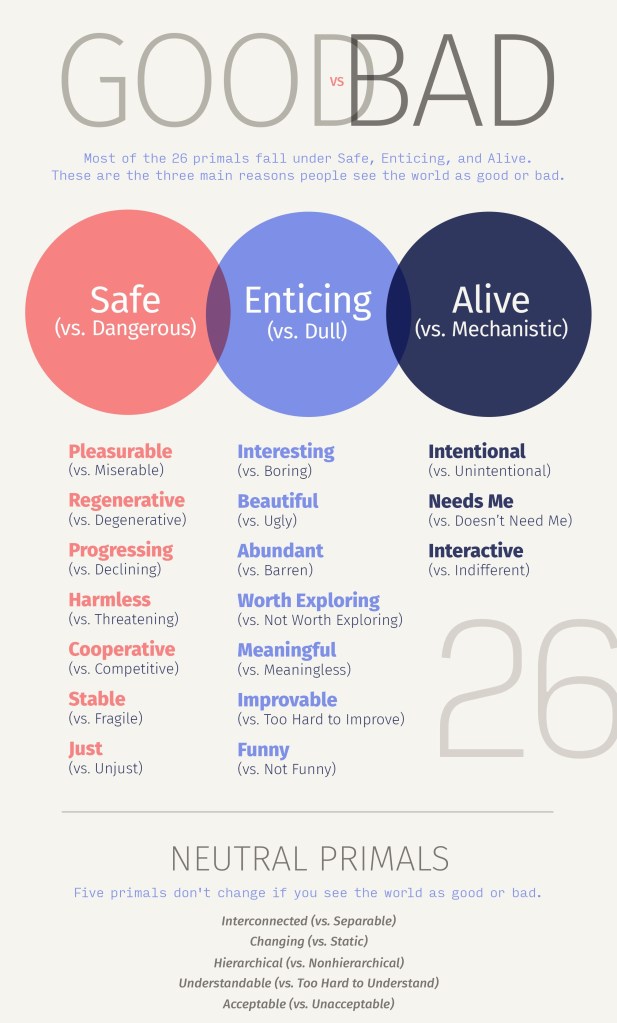
It turns out that most people in our studies—and perhaps you, too—hold 22 distinct beliefs about the world as a whole. That’s a lot. Fortunately, most of these cluster into 3 overarching beliefs called Safe, Enticing, and Alive. In turn, these 3 overarching beliefs cluster into 1 overarching belief about whether the world is a fundamentally good or bad place, called Good. Researchers call these 26 beliefs primals or primal world beliefs.
Listening to this Hidden Brain eposide is a great place to learn more about primal world beliefs.
But what is “the world”, exactly?
A series of studies found that the 26 primals are specifically beliefs about matters here on earth, not outer space, are roughly as much about humans as they are about nature, and tend to be more about the material than the spiritual world (depending on if you believe in a spiritual world or not).
In other words, primals are your gut-level answers to the question, “What sort of world is this?” Each one can be explored in the drop-down menu at the top of the page under “The 26 Beliefs.”
How We Identified Primals
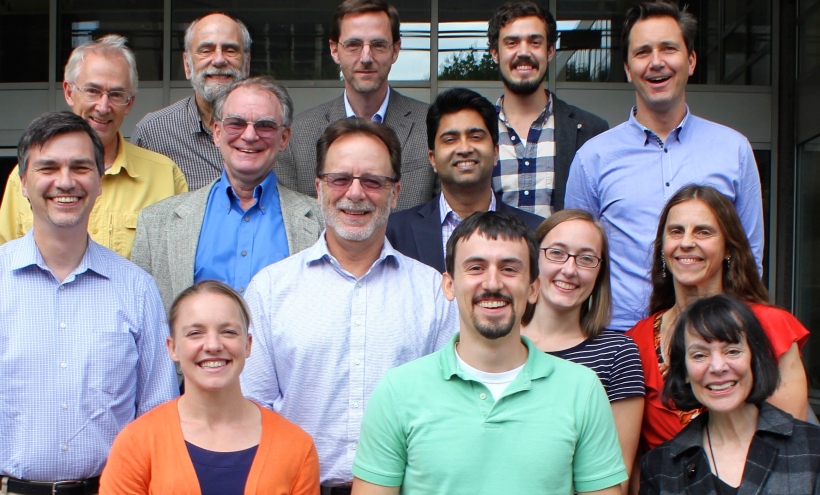
We began by carefully defining what does and does not count as a primal. We then conducted 7 projects over five years to identify potential beliefs, such as conducting 12 focus gourds in all major world religions and studying thousands of tweets that began with phrases like “the world is”.
Through these projects, we identified many candidates for primal world beliefs. Then we used a variety of statistical methods to determine how all these candidate primals clustered within actual people, which ones were statistically redundant, which ones were not psychologically meaningful, and so forth. To learn more about our process in detail, check out this summary or the paper linked below.
In 2019, we published our results in Psychological Assessment, the top psychology measurement journal, to demonstrate that we’re measuring something real. Our paper makes the following two conclusions:
- First, the Primals Inventory (the 99-question version) is a robust, scientifically validated measurement tool for the samples we examined (Americans)
- Second, primals may exert an enormous influence on human behavior.
Find the free full-text version of the foundational 2019 paper here.
Why do primals matter?
Psychologists know that a person’s beliefs about a place influence their behavior while in that place. But what psychologists hadn’t realized is that humans also have beliefs about the world as one giant place. In theory, these beliefs are capable of explaining much of the differences in people’s personalities and wellbeing.
In fact, well-established psychological theories suggest they should explain these differences, or at least part of them. However, in order for that to be possible, primals must (a) vary a lot from person to person (because personality varies a lot, too); (b) stay pretty much the same for each person over time (because personality does, too); and (c) strongly correlate with the wellbeing and personality variables they supposedly cause.

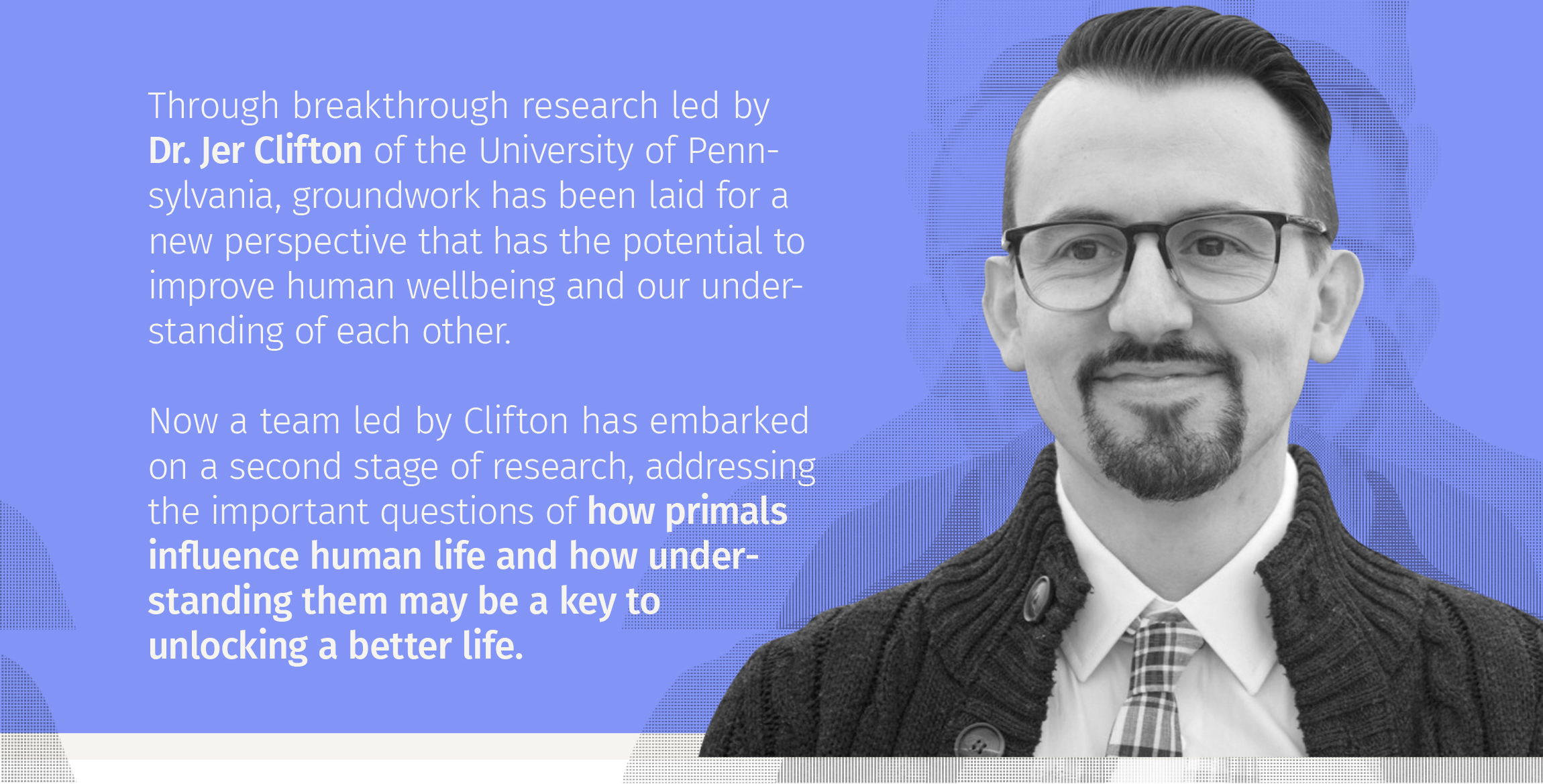
Jer and the research team found that all three of these conditions hold. First, primals vary greatly from person to person, even among those sharing seemingly the exact same local environments, like siblings who grew up in the same household or friends from the same town. Second, in several longitudinal studies, we also found that primals are stable over time, though some daily fluxuation does occur. Third, primals are very predictive of how people live their lives.
For example, there are large correlational relationships between seeing the world as Good and being an optimistic person, seeing the world as Safe and being a calm person, seeing the world as Enticing and exploring it, and seeing the world as Alive and finding meaning in life.
However, we do not yet know what all these relationships mean. There are two basic theories:
First, people have different, largely innate personality traits, including optimism, neuroticism, and curiosity, and these traits cause them to see the world the way they do. If so, primals are interesting but aren’t that big a deal. They are just a symptom of traits we already know people have.
Second, much of human behavior is a reaction to what sort of world you think you are in, defined by your primal world beliefs. For example, optimists and pessimists are realists who happen to disagree about the sort of world this is. Curious people are curious because they see the world as abundant and interesting. Calm people are calm because they tend to see the world as pretty safe, and so forth.
But, because most of us assumed that those who share our planet share our primals, it took researchers a long time to figure this theory out. If it’s true, mapping humanity’s primals, creating a language to discuss primals, and a tool to measure them represents a major breakthrough.
We don’t know yet which of these theories is right. Both are entirely plausible. But everyone agrees that primals deserve a lot more research, and that is now happening.
So, as you explore your primals, feel free to contact us to share your thoughts and ideas. We are also looking for research collaborations.
Our sense is that we have just scratched the surface.

